Reserve Studies
Reserve Funding Models Compared: Full, Threshold, and Baseline
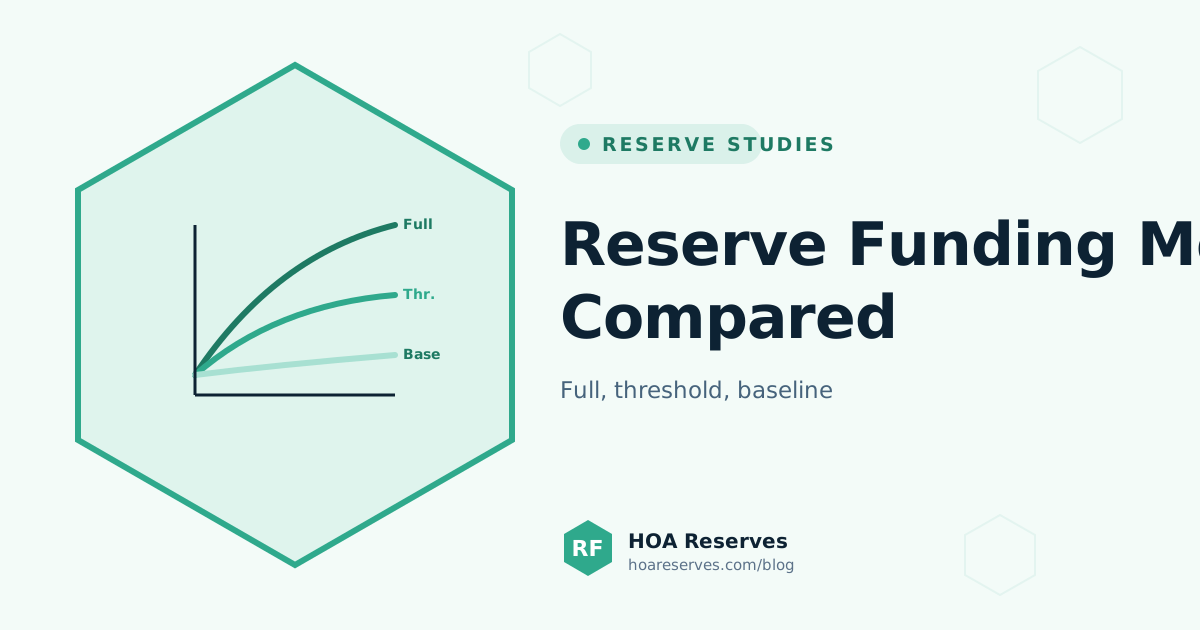
A reserve study doesn't just tell you what you owe — it recommends a funding plan for how to save for it, and there's more than one approach. The funding model a board chooses shapes its dues, its risk, and its long-term reserve health. Understanding the main models — full, threshold, and baseline — helps boards choose deliberately rather than defaulting. Here's the comparison.
The Core Idea: Different Paths to the Same Components
Every funding model aims to have money available when components need replacing — but they differ in how much cushion they build and how much risk they accept. Think of them as points on a spectrum from conservative (lots of cushion, higher contributions) to aggressive (minimal cushion, lower contributions, higher risk). The components and their costs are the same; the models differ in funding strategy. (How reserve funding methods work.)
The Main Models
Full Funding — the most conservative:
- Aims to keep reserves at or near 100% of the "fully funded balance" — the ideal amount given component aging
- Targets 100% funded; every component is fully pre-funded for its age
- Highest contributions, lowest risk, strongest position
- The gold standard, though more than many communities choose
Threshold Funding — the middle ground:
- Keeps reserves above a chosen threshold (a percent-funded floor or a cash minimum) rather than at 100%
- A board might target staying above, say, 70% funded
- Moderate contributions, moderate risk — a balance of cost and security
- The most common practical choice for well-run communities (the 70% benchmark)
Baseline Funding — the aggressive minimum:
- Keeps reserves above zero — never running out of cash — but with minimal cushion
- Contributions are lower, but the community runs close to the edge
- Highest risk: any surprise (early failure, cost overrun) can push reserves to zero and force a special assessment
- Cheapest now, riskiest later
Statutory Funding — where applicable:
- Funds to whatever a state law requires (e.g., a percentage of budget, or non-waivable structural reserves in Florida)
- The legal floor, which may be above or below what the community actually needs
The Trade-Off in One Sentence
Here's the essential trade-off: lower contributions now mean higher risk of a special assessment later. Full funding costs the most but virtually eliminates assessment risk; baseline funding costs the least but courts it. Threshold funding splits the difference. There's no free lunch — every dollar not contributed is a dollar of risk shifted to the future. (The true cost of underfunding.)
How to Choose
The right model depends on the community's priorities and risk tolerance:
- Choose fuller funding when — the community values stability and predictability, has owners who prefer steady dues to surprise assessments, has high-stakes structural components, or wants the strongest position for property values and financing
- Threshold funding suits — most well-run communities seeking a sensible balance of cost and security
- Be wary of baseline funding — it's the cheapest but riskiest; appropriate only with eyes open to the assessment risk, and dangerous as a default chosen just to keep dues low
- Statutory minimums are floors, not targets — meeting the legal minimum doesn't mean reserves are adequate
A key point: don't let baseline funding be the default simply because it minimizes dues. Many underfunded communities got there by quietly defaulting to minimal funding without a deliberate decision. Choosing a model should be a conscious board decision about risk, not an accident of keeping dues low.
The Lender Dimension
Funding model interacts with financing: the GSE rules now expect 15% of budget to reserves (with a reserve-study alternative requiring the highest recommended funding, not baseline). So a community funding at baseline may not satisfy conventional lenders — another reason baseline funding carries hidden costs. Fuller funding keeps the community financeable.
The Bottom Line
Reserve funding models range from full (conservative, high cushion, low risk) through threshold (balanced) to baseline (aggressive, minimal cushion, high risk), plus statutory minimums where law applies. The universal trade-off: lower contributions now mean higher assessment risk later. Most well-run communities choose threshold funding around a healthy benchmark; full funding suits stability-focused communities; baseline should be a conscious risk choice, never a default to keep dues low. Choose deliberately, and remember the lenders now effectively reward fuller funding. For how funding methods work, see Reserve Funding Methods; for the key benchmark, The 70% Funded Rule.