Special Assessments
Special Assessment Payment Plans: Options for Boards and Owners
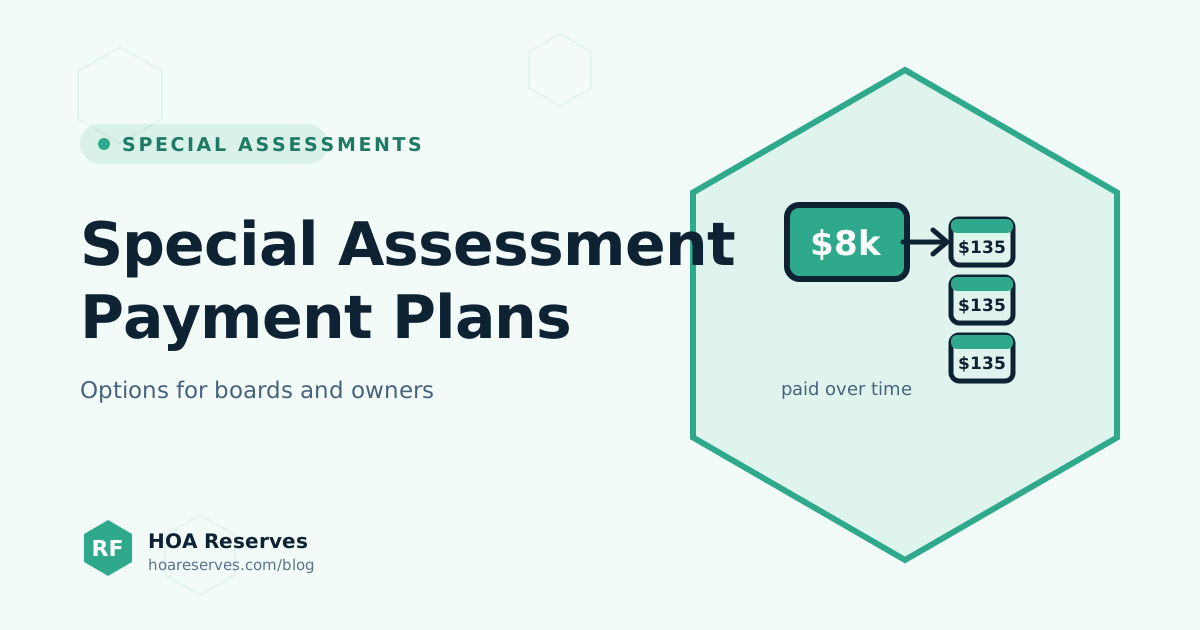
A special assessment of a few thousand dollars can be genuinely destabilizing for an owner asked to pay it all at once — and a board that ignores that reality invites delinquencies, disputes, and ill will. Payment plans are how a necessary assessment gets collected without breaking the people paying it. Here's how they work from both sides of the table.
Why Payment Plans Matter
A community is only as collectible as its owners are able to pay. Demand $8,000 in 30 days from a building full of fixed-income retirees and you'll get delinquencies, liens, and a cash-flow problem of your own making. Offer the same $8,000 as
For boards, structuring the assessment well is part of doing the job responsibly — it's the difference between an assessment that funds the project and one that spawns a wave of unpaid accounts.
What Boards Should Offer
When levying a significant assessment, build the payment structure into the plan from the start:
A lump-sum option — some owners prefer to pay once and be done; let them, often with no penalty or even a small discount if cash flow allows.
An installment option — a defined schedule (monthly or quarterly) over a set term. The term should bear some relationship to the project: a multi-year repair funded over a couple of years feels fair; a 10-year payoff for next month's work may not.
Clear terms in the notice — the amount, the options, any interest on installments, the deadline to elect a plan, and the consequences of nonpayment. Owners challenging an assessment often do so because the notice was unclear; specificity prevents disputes. (What makes an assessment valid and enforceable.)
Consistency — apply the same options to all owners. Selective terms invite fairness complaints and legal exposure.
A note on interest: if the association is fronting costs or borrowing to do the work while owners pay over time, charging modest interest on installments is reasonable and common — it keeps owners who pay early from subsidizing those who stretch it out.
When the Board Borrows Instead
Sometimes the cleaner structure is for the association to take an HOA loan and have owners repay it through their regular assessments over time, rather than running an in-house installment program. This spreads a large one-time cost across years, brings in money immediately for the work, and shifts the administrative burden to the lender. It costs interest, and lenders scrutinize reserve health before approving — but for big projects it's often simpler than collecting hundreds of individual installment plans. The trade-offs are covered in HOA Loans vs. Special Assessments.
Options for Owners
If you're an owner facing an assessment and the lump sum is hard:
- Take the association's installment plan if offered — it's usually the cheapest financing available, often at low or no interest
- Compare outside financing — a HELOC or personal loan might beat the association's installment interest, or might not; run the numbers before assuming
- Ask, don't ignore — boards generally prefer a paying owner on a plan to a delinquent one heading toward a lien; if no plan is offered, request one in writing
- Don't simply refuse — the consequences of nonpayment (fees, liens, foreclosure) dwarf the cost of arranging a plan
The Tax and Disclosure Footnotes
Two quick points owners ask about: special assessments for capital improvements may affect your cost basis (relevant at sale — worth asking a tax professional), and pending or recent assessments generally must be disclosed when you sell. Neither changes the obligation, but both matter for planning. (Assessments and home sales.)
The Pattern That Avoids All of This
Payment plans manage the pain of an assessment; they don't remove the underlying cause. The communities that rarely need them are the ones with healthy reserves — because predictable costs were funded gradually through dues instead of dumped on owners as a lump sum. A payment plan is a humane response to a problem that good reserve planning mostly prevents. For the full assessment picture, see HOA Special Assessments: The Complete Guide.